Friday, November 4, 2016

Guilford's Hymowitz Takes Lacrosse Game to Israel

            Jake Hymowitz saw his junior season with the men’s lacrosse team come to an early end last spring as he suffered a knee injury prior to the 2016 campaign. But before returning to the team for his senior year, Hymowitz spent his summer spreading the game of lacrosse internationally.
            Andrew Landsman, a goalie for the Israel National team who helped it to the 2016 European Lacrosse Federation Gold-Medal Match, reached out to Hymowitz via Facebook Messenger about an opportunity to play in Israel. Landsman represented Israel Lacrosse, the organization that runs the Israel Premier Lacrosse League (IPLL). Israel Lacrosse’s goal is to spread the game and spark interest in the sport throughout the country.
            “I was excited to spend the summer playing lacrosse in Israel,” said Hymowitz.
            Along with many other Jewish-American college players, Hymowitz participated through a birthright trip offered by Israel Lacrosse. The trip is free of charge for the athletes.
            Upon arrival, the birthright players had the opportunity to scrimmage the Israel National Lacrosse team and won, 17-2.
Israel’s National team is comprised mainly of Jewish-American players. Israel Lacrosse hopes the IPLL spreads the game to the citizens of the country so more Israeli-born players fill the roster.
            Hymowitz played defense for a lacrosse club located in the city of Be’er Sheva. It was the club’s debut season and it hired Jordan Hirsch as head coach. Hirsch played at Nazareth College in New York and was a member of the 2004 team that reached the Division III National Championship game. He briefly served as an assistant coach at Guilford’s Old Dominion Athletic Conference (ODAC) rivals Hampden-Sydney College (2008) and Lynchburg College (2008-2010).
            Hymowitz and the team had their first match with Haifa LC, a 5-4 Be’er Sheva victory. The city of Haifa did not have an official lacrosse team, so Haifa LC was composed of the Israel National team, which used the league play as preparation for the European Championships.  Hirsch’s team overcame the lack of preparation and Hirsch’s absence.
“We played our first game without a coach, and having met each other the day before,” said Hymowitz. “We were like a family by the end [of the season]. This game started our bond.”
 In the city, most of the community had not previously heard of lacrosse. This summer marked the first year lacrosse was introduced to the youth of Be’er Sheva.
            “Most people were more confused than excited at first, because they had no idea what lacrosse was,” said Hymowitz. “People looked at us like we were crazy. We carried six-foot poles and equipment while sporting the same logo as their soccer team (Be’er Sheva FC).”
            Be’er Sheva LC’s success promoted the sport throughout the city. Hymowitz and his teammates worked with Sticks for Kids, a program that connected players with local youth through lacrosse.
            “Every time we showed up to a school to teach a clinic, the kids were beyond excited, especially as we started to win games and get more recognition,” said Hymowitz. “Some kids even asked for autographs, which was a crazy experience.”
            Hymowitz and his teammates also worked with the Be’er Sheva youth lacrosse team that formed in conjunction with the official club team.
            “These U15 kids who started practicing and playing when we did had never played lacrosse before,” said Hymowitz. “They were always excited to come out. To see how they progressed and got better over time was great.”
            Be’er Sheva won the nationally televised IPLL championship game at the end of the season and finished with a 7-1 record. It defeated Haifa LC once again, in the title round, 11-10, in overtime of the championship game held at Wolfson Fields in Tel Aviv.
            After graduating, Hymowitz wants to play for the Israel National team. However, he noted the importance of giving the game of lacrosse to the community.

            “The playing aspect was fun for me, but that’s not why we were there,” said Hymowitz. “We were there for the kids. We were there for the kids and the game.”

Friday, May 8, 2015

Student Body President Molly Anne Marcotte Running on All Cylinders


Sophomore Molly Anne Marcotte is one of the best distance runners on Guilford College’s track and field team. This year she decided to run for the Community Senate presidency. Marcotte won the race, and now seeks to help usher Guilford through difficult times. She is believed to be Guilford’s first active varsity student-athlete to preside over the student body in at least 25 years. Marcotte hopes her experience as a ballet dancer and identity as a feminist, student-athlete and fitness guru will help her be a successful president. 

As president, one of Marcotte’s goals is to provide equal representation to all Guilford students, which will likely require a bit of a balancing act. Marcotte knows the drill well after being offered a chance to pursue a professional ballet dancing career by Joffrey Ballet School in New York City. The demands of ballet were too high for Marcotte to accept the offer. She wanted to apply her energy elsewhere—namely, humanitarian endeavors and track and field. As an NCAA Division III school, Guilford supports her ambitions and affords her the opportunity to be a proactive member of the community.

Once Marcotte arrived at Guilford she immediately became involved in campus activities aimed at helping others. She is passionate in her roles with the Community Aids Awareness Project, the Sexual Assault Awareness Support group and Community Senate. Marcotte also holds prominent positions as a judicial affairs chair member and a peer health and wellness intern for the Wellness Education Department. These activities reveal her first love: public health. “I’m very passionate about that because when your health isn’t up to par, you won’t function efficiently.” Functioning efficiently is how Marcotte is able to excel as a student, athlete and leader simultaneously.

“If anyone is going to balance athletics and academics [as president], it’s [Molly],” says Guilford assistant track and field coach Kimberly Cash. In her short time at Guilford, Marcotte has taken on increasing burdens without ever losing a step. She was a sprinter at first, but moved into middle distance during the 2014 outdoor season. Marcotte extended her distance as a sophomore, adding the 3,000- and 5,000-meter runs to her repertoire. Next year, Marcotte may take on the most grueling task by running the 10k. Head track and field coach Danny Cash says she has grown from her freshman to sophomore year by absorbing information about athletics and academics and translating it into the person she is today.

A huge part of the person Marcotte is today is her intersectional feminist philosophy. Her beliefs speak for themselves when discussing how her feminist identity might help her as president. “Feminism isn’t feminism unless we are inclusive of all races, genders, sexual orientations, bodies, income levels, ages, occupations, regions, ethnicities—we need to include it all.” Marcotte wants to bring this all-encompassing approach to Guilford’s student politics.

Marcotte’s role as a Guilford student-athlete is also very important to her. “Molly is very dedicated, very goal oriented and one of her best things is she’s very good with time management,” says head track and field coach Danny Cash. He says these skills, as well as working well in a team environment, will transfer to the presidency. As a student-athlete who paces herself on the track and in the classroom, it is not hard to imagine Marcotte adding student-body president to the mix and approaching the responsibility with equal poise.

“Once she [becomes president], it won’t take her long to figure out everything and know what’s going on,” says Danny. With two full years left in her undergraduate experience to affect Guilford’s future, Marcotte’s past experiences have prepared her for the times ahead. “Molly won the presidential race due to her never dying perseverance, intuition, dedication, and her firm beliefs in making sure that Guilford's seven core values are evident in the student body and Guilford community,” says friend Ava Nadel. This description alone reveals a wealth of character.

"Nothing is holding me back from trying to be one of the people on an executive team trying to affect change in the community,” Marcotte says. The desire to change Guilford will come to bear next year. At the top of her list are issues such as administrative and budget transparency, community activism, student representation, the issue of retention and multicultural educational programming. As a former ballet dancer, current student-athlete, feminist and workout warrior, Marcotte is ready to be the change Guilford requires.

- by Jacob Kapp ‘15

Friday, May 1, 2015

Tennis Rackets Saved by Votipka's Spiritual Journey

   Life as a tennis racket early in Turner Votipka’s career was a dangerous pastime. “I went through two a year, at least, in high school,” the Guilford College senior said. He had even broken two rackets in one match before.

“I would let rage overcome me.”

Now a graduating senior, Votipka is Guilford College’s number-one tennis player and much has changed since his racket-breaking days. He is a team captain and received the school’s prestigious Nereus C. English Athletic Leadership Award. His junior year proved a transformation had taken place as he had three rackets at one time. “It was cool. I’ve never had three rackets at once before,” said Votipka.

What changed? Votipka had a spiritual blossoming.

Votipka grew up in a traditional Baptist setting near Rocky Mount, North Carolina. His mom worked for the church. “But my understanding of church growing up was that God loved me…but I needed to do good things to live that life out.” Votipka says he did whatever he was told because he believed that was his ticket to heaven.

Votipka decided to join a Bible study his freshman year at Guilford. “He came to the Bible studies we had, but it seemed like he came because he felt compelled. Trying to have a serious conversation with him was like pulling teeth,” said Mike Gatton ‘12, who helped lead the studies as a campus minister for the Fellowship of Christian Athletes. Eventually Votipka opened up and was exposed to the radical idea of God’s unconditional love. With this revelation, the seed was planted for a metamorphosis in Votipka’s belief system. He calls it a “holy crap” moment.

After his freshman year, Votipka went to Myrtle Beach, South Carolina, for Summer Beach Project, organized by the campus ministry organization Campus Outreach. For eight weeks Votipka participated in ministry, held a full-time job and did community service. “They pound in knowledge about the Bible,” he said. But this was not the biblical understanding he grew up learning at home, but the radical notion of God’s complete and unmerited love.
Votipka points to a passage from the book of Isaiah as an instance of God’s unconditional love.

“But Zion said, ‘The Lord has forsaken me, the Lord has forgotten me.’ Can a mother forget the baby at her breast and have no compassion on the child she has borne? Though she may forget, I will not forget you! See, I have engraved you on the palms of my hands; your walls are ever before me.” (Is. 49:14-16)

Votipka previously believed the verse meant God held believers in His hands only so long as they retained His favor through good deeds. “But once you’re saved…we will sin, but God will bring us back,” Votipka said of his new understanding. After the summer in Myrtle Beach, Votipka realized he may be living a good life, but not the right life.

Following Beach Project, Votipka increased his involvement in Christian-oriented activities over the next few years. Every winter Votipka attended a Campus Outreach New Year’s Conference where he heard various pastors and fellowshipped with students from across the region. “This was where things really started going,” said Votipka. Gatton agreed, noting by Votipka’s third year the transformation was evident.

“There are a lot of guys who are like ‘poof,’ my whole eyes are open,” Votipka said. “But things started revealing themselves more and more to me.” Votipka did not experience an instant change, but gradually shed old beliefs to form a new ideology.

Erik Meiler '16 (l), Turner Votipka '15 (r)
Head coach Dave McCain calls Votipka a ‘grinder.’ His game is not flashy, but relentless, predicated on keeping the ball in play and forcing opponents to make mistakes. “His work ethic transfers to the other players,” said McCain. That’s partly why Votipka is the team captain.

Votipka is a leader in other ways as well and received one of 2015 Guilford’s Nereus C. English Athletic Leadership Awards, the school’s top athletics honor. It is not only his work ethic that transfers, but his religious ethic as well. He began a Bible study on campus and embraced church life as a member of Friendly Hills Church in nearby Jamestown. Now Votipka helps organize church events like a lock-in for youth and is president of Guilford’s Fellowship of Christian Athletes chapter. “He has definitely grown in his maturity and has realized the unique opportunity he has to impact others in this time and season of life,” says Dave Walters, a fellow church member and Guilford’s sports information director.

“I’m no longer doing things so I get a benefit,” said Votipka, “but I’m doing them for God and getting joy and happiness from it.” As a leader and student-athlete this mindset is crucial. Gatton says Votipka isn’t a preacher, per se, but leads by example.

“You have to learn to love the people you’re leading and do whatever for them,” said Votipka. “Whether that’s yelling at them to get straight or sacrificing your time to go out of your way to do something.” McCain says the biggest change he has witnessed in Votipka is his growing leadership skills.

“Every [tennis] match is not an end, but a journey. Something to enjoy,” said Votipka.

The same ultimatum applies to spiritual matters as well. He says he worshipped tennis at one time in his life, but he’s found more fun and purpose following God, which is good news for tennis rackets everywhere.

-by Jacob Kapp '15

Friday, April 3, 2015

Focus and Precision Help Keene Master Draw Control and More


Eleanora Keene has accomplished much in her illustrious career at Guilford College. She holds top-10 positions in Guilford’s lacrosse history in points, goals, ground balls, and caused turnovers—all by the end of her junior year. The midfielder is a three-time all-region and all-league performer. She may be remembered most by her command of the draw control, a category in which she currently ranks sixth all-time in NCAA Division III history. The same tenacity that drives her in lacrosse feeds her off-field exploits.

Sports were unavoidable for Keene growing up. She hails from an athletic family that includes a cousin who played lacrosse for the United States National Team. This environment is a large reason why lacrosse head coach Sarah Lamphier calls Keene, “An unbelievably consistent athlete.” Despite her lineage, she did not originally intend to play a sport in college.

Although Guilford was one of Keene’s first choices, she was not totally set on playing lacrosse here. “On moving day, my dad found the [former] lacrosse coach and brought him to my dorm,” she recalls. Keene says deep down she knew she was always going to play lacrosse, it just took some prompting.

Keene didn’t expect to dominate the play used to start the women’s game at both halves and after goals. Now a magician at the draw control, Keene never assumed that role before college. She often lines up against her opponent at midfield with the ball carefully placed between the two sticks by an official. When the whistle blows, the players hurl the ball into the air and Keene usually comes up with the important possession.

“Each draw is an opportunity to have control of the game,” says Keene. “If you win the draw and you have a competent attack, you will score and control the pace of the game.” She says the importance of the draw control is second only to the scoreboard.

The number-one rule of winning the draw? “Never take your eye off the ball!” says Keene. Most people stare at the referee for the cue, but Keene’s eyes are locked on the ball. Boxing out, timing and predicting the ball’s direction are also important guidelines to a successful draw control. It doesn’t hurt that Keene stands 5-foot-7, which usually makes her one of the game’s taller players.

“All aspects of lacrosse are physically tiring, but the draw for me is more mental,” says Keene. Thorough concentration and mental toughness are necessary to master the draw control. “Each one is basically another beginning and you have to bring the same energy and focus to each one to be successful.”

Keene calls getting into “the zone” the most critical mental element of winning the draw control. She drops into this mindset often as an art major. Keene describes both painting and playing lacrosse as getting on a roll. “On the field, I get that runner’s high. You don’t get tired. You’re on a different level,” she says.

Keene is a perfectionist. “I get this itch to get things finished,” she says. This approach has certainly paid off in lacrosse. If the ball is on the ground or unpossessed Keene is not satisfied until it is in her crosse. “Nora has always been consistent since freshman year and has been breaking records almost every year since then,” says teammate Anna Howard. Keene’s teammates joke that her stick is a magic wand given how excellent she is at fielding the ball. “She helps us win and be successful from the draw,” says Lamphier.

Keene could have attended an NCAA Division I school. She decided not to when family members showed her how consuming the sport could be at that level. “I wanted to do art, I wanted to travel and have other friends outside of lacrosse,” says Keene.

Keene realized that she had to unleash her passions after studying the first semester of her junior year in Indonesia. “It was so significant and so challenging I wondered why I didn’t just do what I wanted do,” she says. Keene set on following her dreams and vowed to never hold back as a lacrosse player, student or artist.

As she nears the end of her Guilford career Keene looks forward to one day opening her own art gallery in trendy Santa Fe, New Mexico. If she applies the same precision and focus she has as a student and athlete, she will undoubtedly find success beyond Guilford.

- Jacob Kapp ‘15

Friday, March 27, 2015

Faculty Athletics Mentors Work Behind the Scenes for Quakers' Student-Athletes

“Athletes are students first,” says Craig Eilbacher. Guilford’s Faculty Athletics Representative plays a key role along with the school’s faculty advisers to enrich a Guilford student-athlete’s college experience and provide the best education possible.

Eilbacher, a professor of sports medicine at Guilford, is responsible for communicating with the athletic director, serving on search committees for hiring coaches, dealing with NCAA regulations, solving issues student-athletes have with coaches, and maintaining the balance between coaches, faculty and athletes.

Eilbacher describes himself as an arbitrator and mediator. He believes the biggest problem student-athletes face is time management. Figuring out how to plan out one’s day ties into the tricky situations presented by scheduling conflicts with athletics and academics.  “I push athletes to have an open line of communication with the faculty,” he says. Eilbacher says this medium of exchange helps prevent clashes arising from various tournaments and rescheduling conflicts. When athletes are unable to reach solutions with their professors, Eilbacher steps in to reach consensus.   

Eilbacher says student-athletes are not just jocks. “Guilford’s campus is very vibrant,” he says, listing various activities such as theater, art and clubs. Eilbacher encourages student-athletes to branch out and embrace these aspects of campus life. “Whether you are a student, or a student-athlete, you represent Guilford College with distinction.”  

If Eilbacher addresses issues at the institutional level, faculty advisers cater to individual concerns.

Garland Granger (right) is one such faculty adviser. His tenure began as an observer attending baseball practices to watch his nephew. The Guilford accounting professor quickly developed relationships with other baseball players. When head baseball coach Nick Black ‘02 subsequently asked Granger to take on a new role, he became much more than an observer. He became a faculty adviser—or, as Granger likes to call it, a mentor.

Granger is not the school’s only faculty adviser. Their ranks also include Guilford faculty members Heather Hayton, Kyle and Erin Dell, Barbara Lawrence and numerous others who personalize the student-athlete’s college experience. As Granger puts it, “Faculty advisers bridge the gap between athletics and academics.” 
The impact of faculty advisers is both big and small.

Basketball player Will Koppenhaver prepared to transfer after his freshman year. When Hayton (left), the team’s faculty adviser, asked Koppenhaver for one more semester, the power forward listened. In the year that followed, he traveled to the Himalayas as part of a study abroad program and became a better student with Hayton’s help. Koppenhaver will graduate from Guilford this May and started all 26 games in his senior season

Faculty advisers also help in more nuanced ways. Granger recalls when first basemen Chuck Noble struggled to hit the baseball. Granger, who previously played tennis, told Noble to focus on his technique. “When you get up to the plate, take three deep breaths,” Granger said. “What that does is force your muscles to relax.” In the next few games, Noble piled the stat sheet. Days later, Granger received a note from the first baseman, “Thanks for the advice.”

Black says Granger assists students who are unable or afraid of building a bridge with faculty themselves. These relationships can help address any academic-related issue: professors, exams, expectations or life beyond Guilford. 

“The role mostly involves being a sounding board, adviser and resource for the team as they navigate through Guilford,” says Kyle Dell, adviser to the soccer team. Advisers also fulfill a role for student-athletes that coaches cannot. “Coaches aren’t on the academic side of things,” says Black, “so we aren’t able to bridge that gap.” Faculty advisers fill this void for student-athletes by maximizing the educational opportunities Guilford offers.

Faculty advisers have a unified goal. “My greatest gift with students is to instill courage,” says Granger. He says the faculty adviser’s role is to stand beside student-athletes and push them towards improvement while also aiding them in the trials of being both a student and an athlete. “As someone that came through a small liberal arts college myself,” says Dell (right), “I know how important it can be to have personal connections throughout one's different roles in college--as a student, as an athlete, as a leader of a club or even just as a person.” What Dell, and other faculty advisers do, is attempt to establish that connection.

Granger says he stumbled into the opportunity to become faculty adviser. The Dells were offered the job by head soccer coach Jeff Bateson. The three established a relationship during club soccer events. Thanks to the longtime assistance recently retired professor Kathy Adams provided as adviser, Bateson realized the role’s importance for student-athletes.

“This is a position I really wanted,” Eilbacher said. “[I like] working with as many people as possible to make things run smoothly.” Eilbacher relishes the challenge of finding balance between athletics and academics to make the student-athlete’s experience as fulfilling as possible.

“We want to maximize the athlete experience,” says Dave Walters, Guilford’s Sports Information Director. “But at the same time, we want athletes to be successful as students. When student-athletes leave Guilford, we know it will be their education that helps them with gainful employment.”

Faculty advisers can personalize a student-athlete’s Guilford experience and Eilbacher helps maintain an infrastructure that stimulates student success. Both build bridges for present and future endeavors of Guilford’s student-athletes. 

- by Jacob Kapp '15

Monday, March 2, 2015

Guilford's Will Koppenhaver Finds His Way On and Off the Basketball Court Through Helping Others

Frustrated, injured and disenchanted, freshman Will Koppenhaver walked into the office of basketball faculty adviser Heather Hayton. A few months into his college career, Koppenhaver’s original purpose for attending Guilford College had not panned out. He wanted to play basketball. He also liked the campus and Guilford’s strong focus on service and diversity. “If students wanted to act on something that they felt strongly about, then they could,” Koppenhaver said. But being relegated to the bench for the Quakers’ basketball team and unable to find a worthwhile community, Koppenhaver felt anything but empowered.

“Give me one more semester,” Hayton asked the disgruntled 6’6’’ power forward that day in her office. Koppenhaver sat across from the English professor pondering his decision on whether to transfer. He heeded her request.

Now, over two years later, Koppenhaver has concluded his Guilford basketball career after starting all 27 of the team’s games as a senior. He is ready to don the cap and gown with his fellow Guilford seniors this May. Getting to this point, however, was a quest of self-discovery where Koppenhaver exited his comfort zone and came to grips with his dreams of helping people.

Koppenhaver was born in Durham, North Carolina but relocated multiple times until he landed in Boone, North Carolina where his father teaches English at Appalachian State University. Throughout his youth he followed in his mother’s footsteps with involvement in Habitat for Humanity. “I am all about empowerment in the instances of service to others—especially for the good of others,” Koppenhaver said. Now, his post-graduation plans are in motion: Koppenhaver wants to join AmeriCorps—even if it means being paid on the poverty line. His goals crystallized when Koppenhaver struck the balance of student and athlete with Hayton’s help.

Hayton recalls the moment when Koppenhaver first approached her. He was frustrated and aggravated in his body posture. She wanted to find him a community outside of basketball where he could find direction. “As a mom, I immediately fell in love with him,” said the diminutive Hayton. “Here was a giant who wore his heart on his sleeve.” 

The first step towards Koppenhaver’s self-discovery was enrolling in Guilford’s Honors program and getting accepted into the school’s Principled Problem Solving Program. The Center for Principled Problem Solving cultivates students who possess the knowledge and moral values to tackle complex social problems and effect positive change. Koppenhaver was a good fit for the program.

Koppenhaver took a break from basketball for his sophomore season. “I think I needed to be 
away from the team,” he said. “I had a negative attitude.” During his time away from the team, Koppenhaver expanded his horizons by participating in non-profit endeavors like building houses and even planning a hip-hop concert. The biggest step, however, happened during a study abroad trip to Sikkim, India, during in the summer of 2013.

“I wanted him to go to India because it’d be good for him,” Hayton said. “But, second of all, so I could help direct him for the next stage in his life.” Koppenhaver did not expect to be the sole male in a group of nine females, including Hayton. With car rides lasting up to five hours, India was a reckoning experience in more ways than one for someone used to male-dominated circles. For a month Koppenhaver did historical and cultural studies about Sikkim and the surrounding area. He also participated in a variety of service projects aimed at helping the local populace.

“I know it sounds cliché, but it was life-changing,” Koppenhaver said. “It was humbling to see how other people live without iPhones and TVs—all the materialistic things we Americans take for granted.” Koppenhaver realized that he did not have to help everyone, and that people can live differently than him. Hayton noted Koppenhaver was finally able to get out of his own head and see the world from a different perspective. That revelation did not change his desire to help people, but reinforced it.

Being unable to change everything reignited Koppenhaver’s desire to play basketball. This came in spite of four months recovering from a torn meniscus at the end of his freshman year. Now a junior on the team, Koppenhaver was transformed. “Will is a great team player who is willing to sacrifice his personal stats and goals for the good of the team,” said coach Tom Palombo of the now-senior.

But that statement was not always true, hence the visit to Hayton’s office. Now a regular starter, “It’s nice to be sore after games,” Koppenhaver said. After his visit to India, Koppenhaver became more patient and overcame his anger and frustration, which helped both on the court and in shaping his career.

“Heather gave me a bunch of options, and that was the big turning point in my personal and academic life,” Koppenhaver said. If it were not for individuals like Hayton and others, Koppenhaver would no longer be at Guilford. “Through her I realized all the things Guilford offers.”

When Koppenhaver walks to the commencement stage in May, he says he will be thinking about how he took advantage of everything Guilford offered. “I didn’t make any mistakes, but just had lessons to be learned,” he said. Eventually Koppenhaver wants to pursue a master’s in business and continue to find ways to help people through non-profit endeavors.

Monday, February 16, 2015

Guilford Alum Plays for Spanish National Baseball Team

Fearless, prepared, passionate.” These are the characteristics Guilford’s baseball coach Nick Black ’02 says define his former player, Borja Jones Berasaluce ‘14. These qualities helped Jones Berasaluce as a four-year starting pitcher for the Quakers from 2010-2014, but would they help him represent his heritage as a pitcher for Spain’s national baseball team? Would they help him realize what he wants to do after earning his degree in sport management?

Borja Jones Berasaluce '14
Born in Newton, Massachusetts, to Thomas Jones and Ana Berasaluce, Jones Berasaluce gained Spanish citizenship through his mother. As a youth, Jones Berasaluce and his family visited Spain often—becoming as much Spanish as he was American. “He always took his Spanish heritage very seriously,” Black said. Following an extended hiatus from the country, Jones Berasaluce fulfilled his yearning to return as a graduation present in the summer of 2014.

While in Spain, Jones Berasaluce could not stay away from baseball after Guilford. He tried out for a local semi-professional team and earned a spot as a pitcher. Then he got lucky. The Spanish national coach attended one of his games to scout an opposing player. Instead, Jones Berasaluce caught the coach’s eye. When asked to play for Spain, “Of course I said yes,” Jones Berasaluce recalled. “When you get an opportunity like that, it’s just something you can’t pass up.”

In the following months, Jones Berasaluce played at various locations on his way to pitching for Spain in the 2014 European Baseball Championship. “An incredible jump,” he called it compared to his pitching days in Massachusetts and North Carolina. His first stop was Italian baseball week in a stadium near Venice, where he helped his team to victory against the Czech Republic and Italy. After this week of preparation, qualifying games for the championship began in Brno, Czech Republic. Spain’s success there allowed it to reach the championship series in Ostrava, Czech Republic. Here Jones Berasaluce experienced what he called a “reality check.”

In a quarterfinal game versus the Netherlands, Jones Berasaluce took the mound in relief with his team trailing 12-8. The bases were loaded. “I threw a great pitch in my mind,” Jones Berasaluce said, “and a big, chubby lefty-hitter put it right out of the park.” It was a reality check because Jones Berasaluce realized he may have got too caught up in the moment. “To [the Netherlands], it was just another game.”

The moment, the pinnacle of his baseball career, caused Jones Berasaluce to reassess his dreams. Along the journey to making the Spanish team, he played alongside teammates who signed with major-league teams as teenagers out of Latin American nations, but were later released. “Seeing these guys who were signed, maybe played a few years and were dropped, they don’t have an education to fall back on.”

Jones Berasaluce’s now sees an opportunity to perhaps help players like his Spanish teammates. “With my ability to speak Spanish, sometime in the foreseeable future I see myself going to law school.” And of course, the type of law of interest involves baseball. The most desirable scenario, according to Jones Berasaluce, would be contract law, where he aids Spanish-speaking teenagers find their way to the big leagues.

“I understand playing baseball won’t be the rest of my career,” says Jones Berasaluce, “but if I can watch it and be around it every day, I’d love to do that.”

2015 Spanish National Baseball Team

by Jacob Kapp ‘15

Wednesday, December 14, 2011

Gates is Guilford's #1 Basketball Supporter


                  It’s fairly common for Division I schools to have fans that do not attend the institution, yet attend every game and follow the team closely. This phenomenon rarely exists at Guilford, except in the case of basketball super fan Andrew Gates.
                  Gate’s affection for the Quakers dates back to 2001 when his older sister, Sarah Gates Keel ’04, attended Guilford.
                   “My sister is 10 years ahead of me and we couldn’t do anything outside of the family except go to Guilford games, ” Gates said.
                  “Andrew wanted to go to Burger King and play in the ball pit, and Sarah wanted to go shopping or something. Basketball is something everybody could be happy with,” said Lynn Gates, Andrew’s mother.
                  Former Guilford associate head coach Matt Parke met Gates, asked him to come to games, and Gates has been coming ever since. Now Gates is on his way to a Guilford diploma as he will be a full time student at Guilford next school year.
                  “To me this is the way basketball should be,” he Gates “These kids aren’t getting full rides to come here. They come to play here because they love the game. It’s more pure basketball to me than Division I.”
                  In the 10 years Gates has been following the Quakers, he’s seen some of the best players in school history as Guilford grew into a national power.
                  “My three favorite players I’ve seen here is a tie between Ben Strong ‘08, Tyler Sanborn ‘10, and Josh Pittman ‘13,” said Gates, who appreciates players that score the ball. “My favorite graduating class would have to be (Caleb) Kimbrough’s class ‘07.”
                  “My favorite game would have to be the Sweet 16 game (against Lincoln Pa.) at Virginia Wesleyan when Jordan Snipes banked in about a 20-foot leaner to send the game into overtime and Ben Strong scored 59.”
                  Gates hopes to be remembered as a positive supporter. “I just encourage. If somebody has a down game, I just go congratulate them anyway. I just want to be there encouraging and supporting.”
                  Lynn Gates agreed saying, “We’re with you through thick and thin and it’s so gratifying to see you grow up and come together as a team.”

King's Journey Leads from Archdale, to App, to Guilford, to the U.S. Army


The road for receiver Ben King from his home in Archdale, N.C. to Appalachian State, to Guilford College, to his eventual spot in the U.S. Army’s Basic Training is one of twists and turns.
It starts at Trinity High School where King was a standout on the gridiron and won a state championship in basketball. King’s efforts in football earned him a spot on Division I Football Championship Subdivision powerhouse Appalachian State’s roster. After redshirting his first year at State, and dealing with debilitating injuries the other two, King transferred to Guilford in August of 2010.
King came to Guilford for two simple reasons. “I came to Guilford because it was close to home and I wanted to play football,” said King.
King’s transfer to Guilford did not lead the Quakers to any wins in 2010 as Guilford went 0-10, but in 2011 King helped the Quakers to two wins including a victory over cross-town rival Greensboro College. He was named Guilford’s game MVP after catching 10 passes for 187 yards and two touchdowns.
King garnered First Team All-Old Dominion Athletic Conference (ODAC) honors in 2011 and Second-Team All-ODAC the previous year.  He was named Third Team All-South region in 2011. He also led the Quakers in all receiving categories in 2010 and 2011 and set a new record for receiving yards in a single game with 251 yards in 2010.
“I think Ben’s success came because he had a lot of talent,” said head football coach Chris Rusiewicz. “He has great speed, quickness, ability to break away on a burst, and his desire to catch the football. When the ball’s up in the air he’s determined to go get it.  For a lot of great receivers that (want to) makes all the difference.”
King left a team that won three Division I FCS National Titles from 2005-07 to join the Quakers. “It was hard for me to go from winning to losing, but that’s part of life. You have to deal with losing, but I learned from it and I feel like it made me a better person overall,” said King.
 After the 2010 former head coach Kevin Keisel was let go. The coaching staff got a complete overhaul for what would be King’s final season and there were new players at quarterback, running back, and receiver. The result was a young and enthusiastic group, but one that still could not compete with the top teams in the ODAC. Factor in Add injuries to starting quarterback Zac Halbert and starting center Faris El-Ali and the Quakers were in for another challenging season.
“I would definitely have loved to win more games, if that had meant not experiencing so much personal success but winning more games I would have traded that in a heartbeat,” said King.
Despite the struggles on the field, King still enjoyed his time at Guilford. “I really had a bond with my teammates from last year. This year I was kind of the old guy on the team, but last year was really special,” said King.
King’s athletic pursuits are not completely done at Guilford as he will compete with Guilford’s  track and field team this spring. He hopes the running will prepare him for his next challenge, the U.S. Army.
After graduating in May King plans on going through basic training in the Army, followed by Officer's Candidate School. He wants to complete his time in the military, travel, and use his training to enter the field of federal law enforcement, which has always been a field of interest for him. If that does not work out King will try o use the business management degree he earned at Guilford.
King says he’ll miss Guilford, but treasures of the past two years. “I will definitely remember being on and off the field with my teammates, having a good time and competing.”

Sunday, December 4, 2011

Smith Finds Success on the Track and in the Art Design World


Smith '14
            Speed is a passion of people. We love fast cars, we love fast boats, but most of all, we love fast people. Guilford sophomore Johnathan Smith has speed, and lots of it. In his rookie year he became Guilford’s first track & field athlete to reach the NCAA Championships. He went on to win All-America honors in both the 100- and 200-meter dashes. During the upcoming indoor season, he will also run the 55- and the 60-meter races.
            “My favorite is the 200,” said Smith. “Towards the end guys start to get tired and that’s when I start to speed up.” Smith made his aptitude for the 200-meter obvious at the 2010 Old Dominion Athletic Conference Outdoor Championships when he won the event and helped Guilford to a fourth-place finish.
            Smith then placed second in the event at the 2010 NCAA Division III National Championships by a mere half second. He also set the school record in a qualifying heat with a time of 21.15 seconds. Smith also earned All-America status in the 100 by finishing sixth with a time of 10.98 seconds. He holds Guilford records in both events
            With such lofty times some might wonder why Smith didn’t try to ply his trade at a Division I school. Smith made it clear his unaccomplished goals at Guilford were the reason for his return.
            “Winning a championship was a big incentive,” said Smith. “We’re building a team from the ground up and I want to help put Guilford on the map.”
            For his sophomore season Smith’s goals are equally lofty. “I want to go to nationals again and try to win a national championship,” said Smith. To this end Guilford sprint coach Marcus Bell has a goal for Smith’s improvement.
            “We want him to get down to 10.5 in the 100,” said Bell.
            Smith, a West Coast transplant by way of Conyers, Ga. came to Guilford to get his art degree and because of the scenic campus. Art was Smith’s first passion as he only picked up track his senior year in high school. As for his interest in art, Smith enjoys web site design and plans on making that his career.
            “I want to work in web design and design websites for companies,” said Smith. Smith worked with the Kaiji Foundation out of Mclean, Va., on building their website design. Smith has also crafted flyers, posters, and made CD covers for various music artists and events. Smith is currently working with fellow Guilford students Travis Robinson and CJ Green on a T-shirt designing project called Unique Critique.
            “This is serious for me for the future,” said Smith. “Right now it’s getting off the ground, but if it gets big, it will be a job for me after college.”
            Though his graduation date is far removed, Smith still has an eye on his future as a runner. “I’m interested in running professionally,” said Smith. “It’s just all about making the times.”
            This is not going to be an easy step for Smith according to Guilford head Track & Field Coach Bill Cason.
            “Right now there’s a level of training out there he doesn’t even know about,” said Cason. “He has all the physical tools. He’s got the DNA, but he’s got to work much, much harder.”
Story By Will Cloyd

Friday, November 11, 2011

Broos Training Room Provides Space for Healing and Learning

Walking through the new Mary G. Broos Training Facility in the basement of Alumni Gym, the first thing that strikes me is the huge space. The old training room only had four treatment tables, but now nine shiny crimson treatment tables flank two walls. In the old room, student-athletes often had to awkwardly hop on counters for treatment on. Now a large, low, gray table connected to an island provides ample work space.

The offices of the new training room

Two spacious offices for staff sit on the back wall next to a short hallway, which leads to an evaluation room for visiting team doctors. In the middle of the training room an island connects with the gray table, which holds various supplies. The old space only had two cramped offices and no private evaluation area. Opposite the offices and evaluation room, twin ice baths provide plenty of space for post practice and post-game soaking.
The old training room, now a refurbished locker room, will serve different teams based on season and need. Athletes and trainers packed in the old space like pedestrians in a subway. I remember vividly student-athletes packing the room looking for treatment. There was always a struggle to accommodate everyone. When we hosted teams there was even less room as visiting teams also needed treatment.
“We can take care of a lot more people a lot faster than we used to,” said assistant athletic trainer Danielle Duffy. “The fact that we can fit a soccer team and a volleyball team and a football team, plus visiting teams, makes our jobs a lot easier.”
Head athletic trainer Gary Rizza also noted how the new facility will help attract students to the college and aid coaches in recruiting.
“Coaches can bring recruits down here with their parents and see what we have in here, as well as what’s out on the field,” said Rizza.
The old training facility, now a locker room
One thing in particular that I like, and visiting recruits will like as well, is the ice bath room. I use the ice baths often after basketball practice and they are great for tired legs. In the old training room, the ice baths were in the main room, sandwiched between the ice machine and two treatment tables. The quarters were cramped and rubber mats were required because the floor was not slip-resistant. I almost fell several times. Now there is more space for the tubs and the floors are designed for wet feet.
Assistant athletic trainer Jared Siglin noted out how the old facility also did not stack up against the competition in the Old Dominion Athletic Conference.
“You look at a place like Virginia Wesleyan, that doesn’t have a football team, and they had a bigger space than we did,” said Siglin. “Four treatment tables (in the old facility) were not enough for all the students we had coming in. We were behind the times.”
Duffy added the old facility did not fit all the people and waiting became an issue. It was also old, occupying the same space since Alumni Gym was constructed in 1950.
The space is named for Broos, Guilford’s athletic trainer from 1978 to 2008, because of her over 30 years of service and to honor her role as a trailblazer in the profession. When she started at Guilford in 1978 she was the only woman in charge of a college sports medicine program in North Carolina. Broos did not expect the room to be named in her honor and was very emotional about the new training space.
“I felt very humbled and very surprised to be honored. I never dreamed about this happening. It was just a shock,” said Broos. “The room will allow students more space to come in and work as well as learn.”
Story by Will Cloyd 

Sunday, November 6, 2011

Musically and on the Pitching Mound, Winterstein is at the Top of His Game


Winterstein '12

Coming off an injury is one of the most frustrating experiences an athlete can go through. Rehabilitation is a difficult experience that presents trial and hardship more than any other athletic preparation. For Guilford senior pitcher Micah Winterstein, aka DJ Skywalker, this frustration was doubled due to the nature of his injury and its consequences.
“In high school l started having pain my junior year in my elbow and the doctor and I weren’t sure what was causing the pain, so I did some therapy,” said Winterstein. What started out as tendonitis led to a tear, and Winterstein underwent Tommy John surgery on his right elbow after his senior year. This procedure takes a tendon from another part of the body and replaces the ulnar collateral ligament in the elbow. This double procedure is highly risky and the rehabilitation process is long.
“After Tommy John it was very discouraging, because there wasn’t an immediate time that I could get back on the field,” said Winterstein.
It was also in high school that Winterstein began to DJ as a hobby.
“It started out as a hobby for sure. Music is something that I really love and have a strong passion for and as I progressively did it more and got better at it, that hobby became something I could use as a job.”
At Guilford Winterstein met, and began to collaborate with hip-hop artist Beau Young Prince, a fellow student. The pair hit it off and opened shows for major artists, such as Chiddy Bang and Wale.
After the surgery, Winterstein didn’t play at all his freshman year and played for the Quakers' developmental baseball team in 2010. Assistant baseball coach Daniel Hadra saw potential in Winterstein and suggested he drop down to a sidearm release from his more conventional over-the-top release.
“Coming off his previous arm surgery, I didn’t see him having a spot on the team. He wasn’t good enough,” said Hadra. “I saw he wanted to play and he’s extremely athletic. I thought dropping down wouldn’t be a drastic change.”
Winterstein’s new sidearm release made him far more effective.
“My strength isn’t blowing by people, but it’s relying on how much I can move the ball and putting the ball where I want,” Winterstein said. “Pitching sidearm allowed me to get more of that movement.”
In 2011 he came into his own as a pitcher. Winterstein posted a team-best 2.45 earned run average in 22 innings. He pitched effectively in 12 appearances out of the bullpen. His effectiveness was even more noticeable due to his interesting pitching style. Entering his senior season Hadra, has high expectations of Winterstein.
“He’ll come out of the bullpen and pitch two, three, four innings. I really want to get to him as fast as I can,” said Hadra. “He (Winterstein) had the best fall of any pitcher on the team. He’s much better than last year. He has much more confidence.”
As for his future as a DJ, Winterstein continues to take music one day at a time. He is not affiliated with any record label, although Popup Shop Records supports Beau Young Prince. The duo continue to collaborate and do shows on campus, as well as off.
Winterstein’s is at the top of his game musically and on the baseball diamond. He’s taking his success and his future plans one day at a time though, for someone who had to overcome so much adversity that only makes sense.

Monday, October 24, 2011

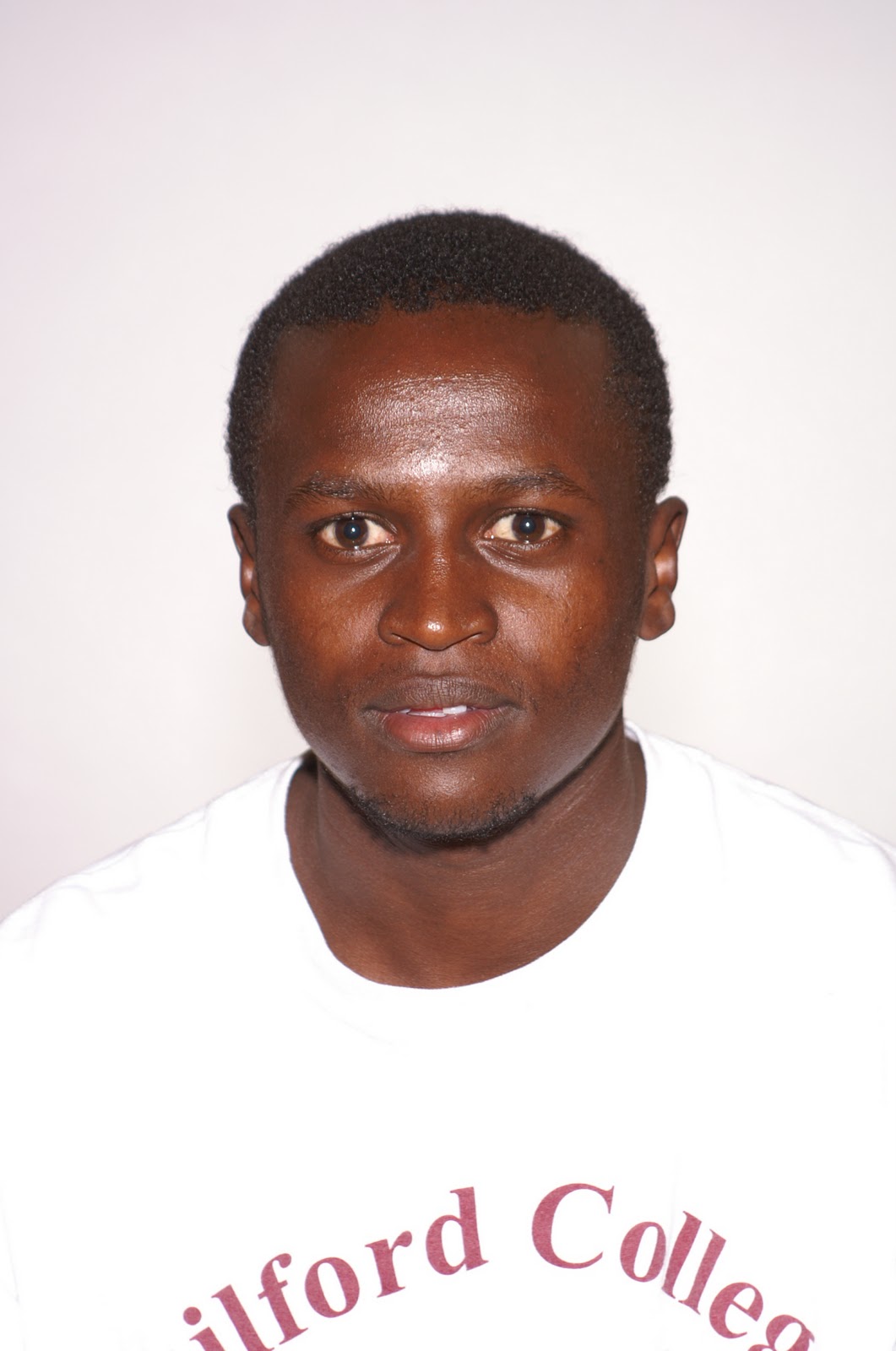
Kosgei Gets Long Overdue Trip Home


Kosgei '12
            On a bright September morning senior Derick Kosgei takes off from the starting line at the Guilford X-C Carnival and a little over 16 minutes later he crosses the finish line with a very solid fourth-place finish, one that helps Guilford’s cross country team win its season-opening meet.
            A little less than a month later, Kosgei is on a plane back to Kenya for the first time in four years after the passing of his grandmother.
            Part of the reason he hadn’t been home sooner is the expensive trip. In order to make this trek, head cross country coach Bill Cason coordinated the fundraising effort, relying mostly on Facebook.
            “It started on a Wednesday night I just sent out some Facebook messages to some friends and a post on the Guilford Track & Field Facebook page,” said Cason.
            Someone at the Greensboro News & Record picked up on the news and ran a story the following day. The money started flowing in from multiple sources.
            “The phone just started ringing and the first guy who called asked how much money we had, about $150, and I said we needed about $2,000, and he said he’d have the check over shortly,” said Cason.
             “It was good to go home, even though everyone was mourning. It was still good to go back,” said Kosgei.
            The trip back home gave Kosgei an opportunity to reflect on what it’s like to live in America as opposed to Africa. “The infrastructure here is much better. The roads, and the technology are better than home too,” said Kosgei.
            Kosgei first went to school at East Central College in Oklahoma then transferred to Guilford. He came to America to run and to get his education.
 “A friend of mine got me into running,” said Kosgei.
            “His brother ran in America and he told me I could be good since I was a better athlete than him.” Kosgei took to running like a fish to water and came across the Atlantic to test his skills.
Since coming to Guilford Kosgei’s hard work earned him 2010 Old Dominion Athletic Conference Runner of the Year and First Team All-ODAC honors. He was also Guilford’s first contestant in the Division III Cross Country National Championships.
Kosgei running at the Guilford X-C Carival
Cason collected $3,000 the day after Kosgei’s story broke, and after the collection was over, he had enough money for multiple trips to Africa, $3,775 in total.
            “The man who donated first was a Guilford grad who hadn’t been back on campus since he graduated. He brought the money over himself, so that was pretty special,” Cason said.
            Kosgei looks ahead to the future with lofty goals and optimism. “My main goal this season is to go to nationals and be an All-American”.
            As for life after Guilford Kosgei plans on staying the course both in his education and running. “I want to go to graduate school and continue to run, maybe run in some competitions,” said Kosgei.
            No matter what lies ahead Kosgei’s trip home was a long overdue homecoming for a young man who spent far too many nights away.