Friday, November 11, 2011

Broos Training Room Provides Space for Healing and Learning

Walking through the new Mary G. Broos Training Facility in the basement of Alumni Gym, the first thing that strikes me is the huge space. The old training room only had four treatment tables, but now nine shiny crimson treatment tables flank two walls. In the old room, student-athletes often had to awkwardly hop on counters for treatment on. Now a large, low, gray table connected to an island provides ample work space.

The offices of the new training room

Two spacious offices for staff sit on the back wall next to a short hallway, which leads to an evaluation room for visiting team doctors. In the middle of the training room an island connects with the gray table, which holds various supplies. The old space only had two cramped offices and no private evaluation area. Opposite the offices and evaluation room, twin ice baths provide plenty of space for post practice and post-game soaking.
The old training room, now a refurbished locker room, will serve different teams based on season and need. Athletes and trainers packed in the old space like pedestrians in a subway. I remember vividly student-athletes packing the room looking for treatment. There was always a struggle to accommodate everyone. When we hosted teams there was even less room as visiting teams also needed treatment.
“We can take care of a lot more people a lot faster than we used to,” said assistant athletic trainer Danielle Duffy. “The fact that we can fit a soccer team and a volleyball team and a football team, plus visiting teams, makes our jobs a lot easier.”
Head athletic trainer Gary Rizza also noted how the new facility will help attract students to the college and aid coaches in recruiting.
“Coaches can bring recruits down here with their parents and see what we have in here, as well as what’s out on the field,” said Rizza.
The old training facility, now a locker room
One thing in particular that I like, and visiting recruits will like as well, is the ice bath room. I use the ice baths often after basketball practice and they are great for tired legs. In the old training room, the ice baths were in the main room, sandwiched between the ice machine and two treatment tables. The quarters were cramped and rubber mats were required because the floor was not slip-resistant. I almost fell several times. Now there is more space for the tubs and the floors are designed for wet feet.
Assistant athletic trainer Jared Siglin noted out how the old facility also did not stack up against the competition in the Old Dominion Athletic Conference.
“You look at a place like Virginia Wesleyan, that doesn’t have a football team, and they had a bigger space than we did,” said Siglin. “Four treatment tables (in the old facility) were not enough for all the students we had coming in. We were behind the times.”
Duffy added the old facility did not fit all the people and waiting became an issue. It was also old, occupying the same space since Alumni Gym was constructed in 1950.
The space is named for Broos, Guilford’s athletic trainer from 1978 to 2008, because of her over 30 years of service and to honor her role as a trailblazer in the profession. When she started at Guilford in 1978 she was the only woman in charge of a college sports medicine program in North Carolina. Broos did not expect the room to be named in her honor and was very emotional about the new training space.
“I felt very humbled and very surprised to be honored. I never dreamed about this happening. It was just a shock,” said Broos. “The room will allow students more space to come in and work as well as learn.”
Story by Will Cloyd 

Sunday, November 6, 2011

Musically and on the Pitching Mound, Winterstein is at the Top of His Game


Winterstein '12

Coming off an injury is one of the most frustrating experiences an athlete can go through. Rehabilitation is a difficult experience that presents trial and hardship more than any other athletic preparation. For Guilford senior pitcher Micah Winterstein, aka DJ Skywalker, this frustration was doubled due to the nature of his injury and its consequences.
“In high school l started having pain my junior year in my elbow and the doctor and I weren’t sure what was causing the pain, so I did some therapy,” said Winterstein. What started out as tendonitis led to a tear, and Winterstein underwent Tommy John surgery on his right elbow after his senior year. This procedure takes a tendon from another part of the body and replaces the ulnar collateral ligament in the elbow. This double procedure is highly risky and the rehabilitation process is long.
“After Tommy John it was very discouraging, because there wasn’t an immediate time that I could get back on the field,” said Winterstein.
It was also in high school that Winterstein began to DJ as a hobby.
“It started out as a hobby for sure. Music is something that I really love and have a strong passion for and as I progressively did it more and got better at it, that hobby became something I could use as a job.”
At Guilford Winterstein met, and began to collaborate with hip-hop artist Beau Young Prince, a fellow student. The pair hit it off and opened shows for major artists, such as Chiddy Bang and Wale.
After the surgery, Winterstein didn’t play at all his freshman year and played for the Quakers' developmental baseball team in 2010. Assistant baseball coach Daniel Hadra saw potential in Winterstein and suggested he drop down to a sidearm release from his more conventional over-the-top release.
“Coming off his previous arm surgery, I didn’t see him having a spot on the team. He wasn’t good enough,” said Hadra. “I saw he wanted to play and he’s extremely athletic. I thought dropping down wouldn’t be a drastic change.”
Winterstein’s new sidearm release made him far more effective.
“My strength isn’t blowing by people, but it’s relying on how much I can move the ball and putting the ball where I want,” Winterstein said. “Pitching sidearm allowed me to get more of that movement.”
In 2011 he came into his own as a pitcher. Winterstein posted a team-best 2.45 earned run average in 22 innings. He pitched effectively in 12 appearances out of the bullpen. His effectiveness was even more noticeable due to his interesting pitching style. Entering his senior season Hadra, has high expectations of Winterstein.
“He’ll come out of the bullpen and pitch two, three, four innings. I really want to get to him as fast as I can,” said Hadra. “He (Winterstein) had the best fall of any pitcher on the team. He’s much better than last year. He has much more confidence.”
As for his future as a DJ, Winterstein continues to take music one day at a time. He is not affiliated with any record label, although Popup Shop Records supports Beau Young Prince. The duo continue to collaborate and do shows on campus, as well as off.
Winterstein’s is at the top of his game musically and on the baseball diamond. He’s taking his success and his future plans one day at a time though, for someone who had to overcome so much adversity that only makes sense.

Monday, October 24, 2011

Kosgei Gets Long Overdue Trip Home


Kosgei '12
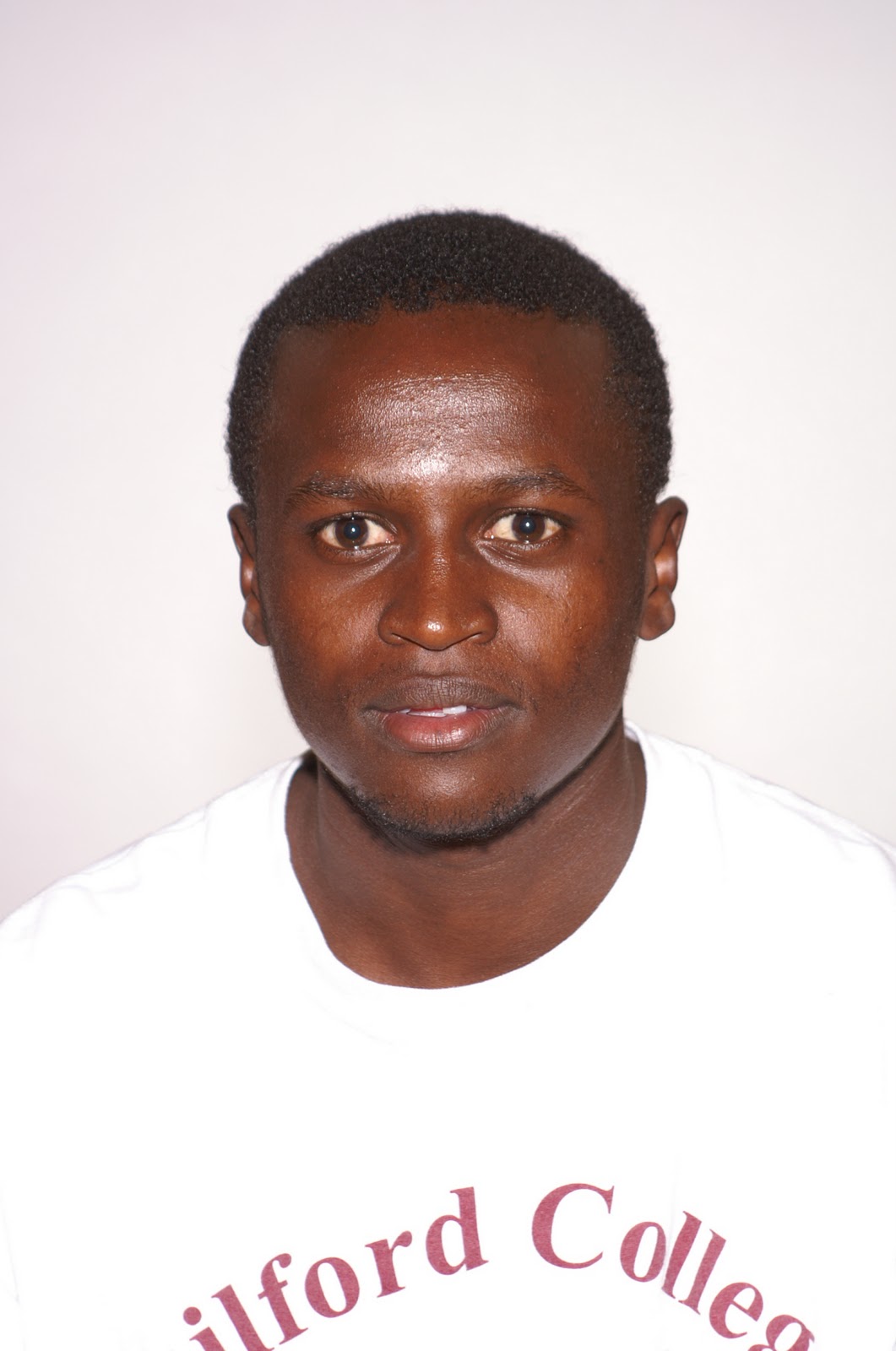
            On a bright September morning senior Derick Kosgei takes off from the starting line at the Guilford X-C Carnival and a little over 16 minutes later he crosses the finish line with a very solid fourth-place finish, one that helps Guilford’s cross country team win its season-opening meet.
            A little less than a month later, Kosgei is on a plane back to Kenya for the first time in four years after the passing of his grandmother.
            Part of the reason he hadn’t been home sooner is the expensive trip. In order to make this trek, head cross country coach Bill Cason coordinated the fundraising effort, relying mostly on Facebook.
            “It started on a Wednesday night I just sent out some Facebook messages to some friends and a post on the Guilford Track & Field Facebook page,” said Cason.
            Someone at the Greensboro News & Record picked up on the news and ran a story the following day. The money started flowing in from multiple sources.
            “The phone just started ringing and the first guy who called asked how much money we had, about $150, and I said we needed about $2,000, and he said he’d have the check over shortly,” said Cason.
             “It was good to go home, even though everyone was mourning. It was still good to go back,” said Kosgei.
            The trip back home gave Kosgei an opportunity to reflect on what it’s like to live in America as opposed to Africa. “The infrastructure here is much better. The roads, and the technology are better than home too,” said Kosgei.
            Kosgei first went to school at East Central College in Oklahoma then transferred to Guilford. He came to America to run and to get his education.
 “A friend of mine got me into running,” said Kosgei.
            “His brother ran in America and he told me I could be good since I was a better athlete than him.” Kosgei took to running like a fish to water and came across the Atlantic to test his skills.
Since coming to Guilford Kosgei’s hard work earned him 2010 Old Dominion Athletic Conference Runner of the Year and First Team All-ODAC honors. He was also Guilford’s first contestant in the Division III Cross Country National Championships.
Kosgei running at the Guilford X-C Carival
Cason collected $3,000 the day after Kosgei’s story broke, and after the collection was over, he had enough money for multiple trips to Africa, $3,775 in total.
            “The man who donated first was a Guilford grad who hadn’t been back on campus since he graduated. He brought the money over himself, so that was pretty special,” Cason said.
            Kosgei looks ahead to the future with lofty goals and optimism. “My main goal this season is to go to nationals and be an All-American”.
            As for life after Guilford Kosgei plans on staying the course both in his education and running. “I want to go to graduate school and continue to run, maybe run in some competitions,” said Kosgei.
            No matter what lies ahead Kosgei’s trip home was a long overdue homecoming for a young man who spent far too many nights away.

Thursday, October 6, 2011

Mercier Making Strides on the Long Road to the Pros

Mercier '14
Sophomore Tyler Mercier has always had to work for things in his life on and off the tennis court. This kid is the best tennis player at Guilford and he's paying his own way through college. Coming from a working-class background in Omaha, Neb., Mercier began working at an early age in various capacities.
 "I worked at Applebee's and other restaurants. I also shucked corn," said Mercier. Mercier's work in the fields of the great Midwest taught him the value of hard work and self-reliance. It also taught him to dream big.
"I plan to go pro (after I graduate)," said Mercier, who has enjoyed his time at Guilford and used the time to work on his game and have new experiences at College.
"Guilford really showed me that I need to get my stuff together, because at home I didn’t really have the tools to succeed," said Mercier, who is also getting a job here in Greensboro.
His work ethic extends to the offseason. Mercier, for financial reasons, cannot go home during the summer and has only been home for about two weeks since he came to Guilford. Instead, he travels to Gainsville, Fla. to live with his aunt and work on his game. Paying for practice space in the Midwest is exorbitant and Mercier can ill afford to waste money, so the arrangements work out.
Mercier, who has a brother and sister who both play college tennis, had a shot to play tennis at the University of Oregon at Eugene, his sentimental first choice, but came to Guilford because he wanted to be the number-one player and because of the influence of head coach Dave McCain.

"He found me on a website and I flew out here for a visit," said Mercier. McCain is a huge part of the reason Mercier chose Guilford as McCain's expertise and experience as a coach appeal to him. McCain helped Mercier excel last year as he won the Old Dominion Athletic Conference Rookie of the Year Award and finished with a 12-3 record as the Quakers’ top singles and doubles player. His goals for this year, however, are even higher.
"I really want to go undefeated," said Mercier. The goal was dashed, however, this past weekend at the ITA Division III South Region Championship where Brian Kowalski of Emory exposed Mercier’s weaknesses on the court, his tendency to take too many risks and let opponents get in his head.
“He faced a guy who just didn’t miss,” said McCain. “Tennis is a game of confidence, once you lose that then it’s tough to win.”
McCain’s praises Mercier’s physical game saying, “ He hits the ball really, really well, we’re trying to get him to open up the court and hit smarter shots.”
McCain also feels that Mercier has a shot at the pros, but that it will be an uphill battle as his mental toughness catches up with his physical toughness.
“About three players playing college tennis play on the tour (each year),” said McCain. He says that as long as Mercier keeps his cool on the court that he will get a shot at going pro.
But for a kid coming from Omaha who came to Guilford with a dollar and a dream, a shot is all he can ask for.
Story by Will Cloyd

Wednesday, September 28, 2011

Midwesterners Have Immediate Impact on Women's Soccer Team


This may be Greensboro, N. C., and at the Division III level it can be difficult to recruit top-shelf talent for women’s soccer, but Guilford head coach Eric Lewis has found a way to get students to Guilford from the Midwest who otherwise might not play college soccer.
            With five students from the Midwest contributing, the team has enjoyed a seven-game unbeaten streak, and has matched its win total from last year, (6). It is apparent that looking for talent away from the Atlantic Coast is lucrative. It’s actually a funny story how it started too.
Hannah Schiltz '15
            “We’ve had several players from Anne Arundel Community College (Md.) come to Guilford and I’m friends with their coach,” said Lewis. “When they made a national tournament in Kansas I went to watch them play. Another youth soccer tournament was going on there and I went and checked it out.”
            At North Carolina youth tournaments, Lewis estimates a one percent return on his recruits. But at the Kansas event, Lewis had three students come to Guilford, about a 15 percent return.
Bri Eilman '12
            “There aren’t that many Division III schools in the Midwest,” explained Lewis. “The biggest hurdle in getting players to come here is convincing them that DIII soccer isn’t recreation league. Once you get past that and they come here, it’s very exciting.”
            In fact there are only 78 Midwest Division III schools that field women’s soccer teams, just 17 percent of the total Division III schools in the country that sponsor the sport.
            As to why players from the Great Plains would want to come to Guilford, first-year Hannah Schiltz of Ashland, Mo., said, “I just wanted to get away. I live in the middle of the country and so there’s nothing really there. I got some looks from DI and DII but I like it here.”
Bre Rolofson '15
            Schiltz is the team’s leading scorer through 11 games with eight goals and ranked second in the Old Dominion Athletic Conference (ODAC).
            Senior Bri Eilman of Omaha, Neb. played Division I soccer for the University of Nebraska at Lincoln but came to Guilford after a back injury. She made an instant impact, earning Second Team All-ODAC honors in her first two years and serving as a team captain as well.
            “My coach kind of gave up on me (at Nebraska),” said Eilman, whose family is good friends with Lewis. “I just came for a visit and I like it.”
            As a matter of fact, the players from the Midwestern states are assimilating well to the eastern sea board.
            “I’m from Platte City, Mo., which is a suburb of Kansas City, so it’s really big,” said first-year Bre Rolofson when asked how she liked living in Greensboro.
On the other hand, Schiltz, from Ashland, Mo., with a population of 2,000, had a much bigger adjustment to make.
            “Living here is a lot different,” said Schiltz. “There are different groups of people and I’m meeting new people, but that’s why I wanted to get out of my little town.”
            With Lewis’ success recruiting in the Midwest he plans to continue making trips to the middle of the country to find talent.
Story by Will Cloyd

Monday, September 19, 2011

Q&A with Guilford Men's Soccer Standout Freddy Gomez

Q: What’s your name and what’s your position?
A: Freddy Gomez, I play midfield and forward.
Q: What is your year in school and your major?
A: I’m a junior accounting and Spanish double major.
Q: What is your favorite thing about being a student-athlete at Guilford?
A: Meeting new people and playing with new players.
Q: What is your favorite moment so far playing for Guilford?
A: Boy, that’s a good question. I’d say playing against Lynchburg last year when we beat them, 2-1.
Q: How was your experience this summer playing for the Carolina Dynamo?
A: Oh great, I mean playing with good players, learning a lot. Just meeting new people is great.
Q: How did the experience help expand your game and your development?
A: It helped me out like getting better with my skills and how to read the game and know the game better.
Q: What do you do outside of soccer or any hobbies you have?
A: I play ping-pong a lot. I do my homework. I watch to TV, and chat with my friends in Chile.
Q: When was the last time you got to go home, or do you get to go home that often?
A: It’s been four years since I’ve been home.
Q: How has that been being so far from home?
A: It’s hard. I mean I live here with my brother and sister and my mom’s back home so sometimes you need that kind of love you know but my brother and my sister being here helps me deal with it.
Q: So since you’ve had some success in the ODAC do you feel any added pressure to perform?
A: Of course. There are people out there watching you play and they know you can do something special.
Q: You know you’re at the top of the scouting report?
A: Yeah, but I just keep humble and do what I need to do to help the team.
Q: For the future do you plan on playing soccer professionally somewhere? Are you trying to go home?
A: I’m trying to go pro here or see if I can go somewhere else. I don’t really want to play in Chile. I want to go either to Spain or Mexico I guess and jump from there.
Q: Have you had any looks from scouts or talked to anyone about that?
A: Not yet, just the Dynamo and we’ll see what’s up after that.
Q: Are you going to play with them next summer?
A: Yeah, definitely.
Interview by Will Cloyd '12

Friday, September 16, 2011

Addie's All Smiles For Guilford Volleyball

She stands arms akimbo on Guilford’s sideline with warm-ups slung nonchalantly over her shoulder, a case of water bottles in her hand, and a huge smile on her face. Her name is Addie Sellars. She is much more than an assistant athletic trainer for the Guilford volleyball team, and she does much more than just hand out water bottles and hold jerseys.

She is a friend and an inspiration.

“She taught me patience. She taught me how to be selfless,” said Courtney Kozar '11, who worked with Sellars for four years out of Lindley Habilitation Services in Greensboro as part of her time with Guilford’s Principal Problem Solvers.

“One of Addie’s goals the first year when Courtney started working with her was interacting with people her own age. She’s been interacting with us and interacting with people that are her own age,” said Guilford head coach Emily Gann.


By achieving this goal Sellars helped the Quakers’ volleyball team in her own way.


“Addie brings a special spark to our team,” said Gann. “When she walks into the gym everyone lights up.”

Sellars not only helps the team on the sidelines, she also helps them on the court. “She helps us to relax and play our game,” said Gann.

A 22-year old graduate of Grimsley High School in Greensboro, Sellars works at Ark Bark selling doggy biscuits. She’s also an avid dancer. Her favorite is the Electric Slide.

Sellars started with the Quakers simply by coming to Quaker volleyball matches and sitting on the sideline, but eventually she accepted the job of assistant athletic trainer and began to develop a relationship with the team.

Sellars is the ultimate team supporter. 


“Somebody could be having the worst game of their career and she’ll still be there with a high five and their water bottle,” said assistant athletic trainer Danielle Duffy.

She brings an enthusiasm and a sense of optimism to the sideline that does not waver, no matter the score or the situation.

“She’s our personal motivator. She passes out towels, she hands out water bottles, and she gets in the circle and dances with us,” said sophomore Taylor Whitley, who now works with Sellars after Kozar graduated last May.

Kozar, Kat Weikel '13, Sellars and Duffy
As for future seasons, Gann hopes Sellars stays involved with the Quakers. “We hope that Addie will be involved for as long as she wants to be. She’s really just a friend who comes and helps out.”

A young woman who was once a stranger to this team came in and made it better, not by making plays or by creating strategy, but with her positive attitude.


Story by Will Cloyd '12